


Digital simulation and sports performance
The challenges of innovation in sport
The practice of sport and associated performance are pillars of human development. The driving forces are numerous and often very personal: health, play, pleasure, reconnecting with nature….
Between democratization and elitism
Between democratization and elitism, sports equipment is becoming an extension of its user. Every improvement, no matter how small, can lead to a real increase in overall performance for the top-level athlete. The ability to adapt athletes’ equipment to new user clusters is a strategic factor in meeting the needs of a large market of both regular users and people with disabilities.
Between tradition and modernity
Between tradition and modernity, each new product must take up the codes and techniques of past successes and meet the expectations of a demanding global market. Performance criteria are specific to each brand, and each project aims to optimize multi-criteria combinations: technical performance of sports equipment, use of bio-based materials, product recyclability, product lightening, grip, user comfort, athlete recovery, energy return, athlete oxygenation, athlete protection, lifestyle while maintaining the desirability of its product.
Developing a product can be a relatively long cycle: design, creation of prototypes, mechanical and biomechanical tests in the laboratory, ‘field’ tests with users… and market trends evolve rapidly under the influence of top athletes, clusters or specialized analysts.
Brands and sporting goods manufacturers are vying with each other in their creativity to enable new communities of sports enthusiasts to combine well-being and performance.
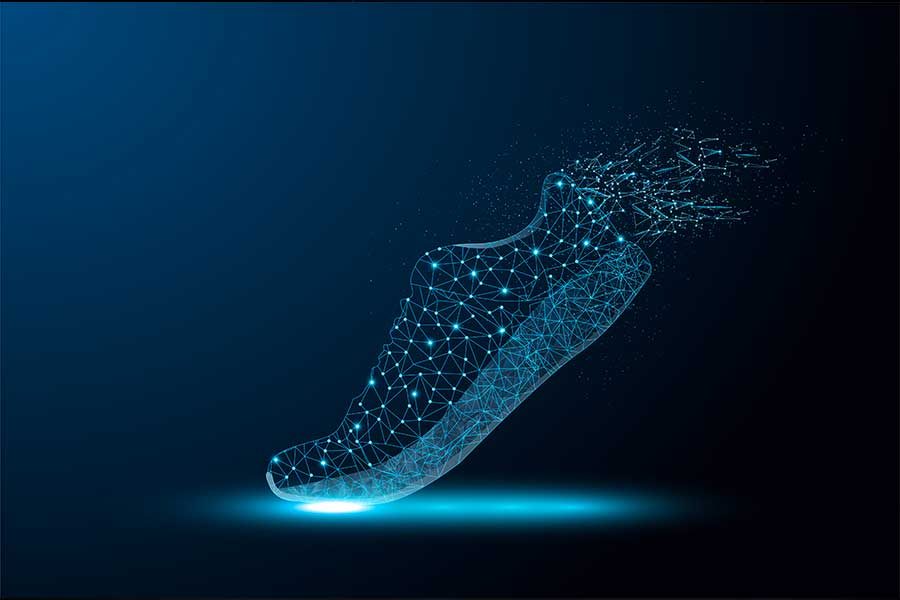
DAES teams contribute to product R&D through numerical simulation and data analysis.
Our expertise in numerical simulation
We support sports brands with a unique team comprising :
- Mechanical engineers specialized in finite element simulation (Abaqus, ANSYS, Isight…)
- Biomechanical engineers specialized in the design of musculoskeletal models (Opensim, Motion Capture)
- Materials experts (carbon, metals, plastics, textiles, PBAX, viscoelastic foams, etc.) from all industrial sectors
- Sports enthusiasts who are also users of the products we help design.
At every stage of product development, we work alongside materials, R&D and innovation engineers, designers and marketing teams, while preserving the brand’s identity.
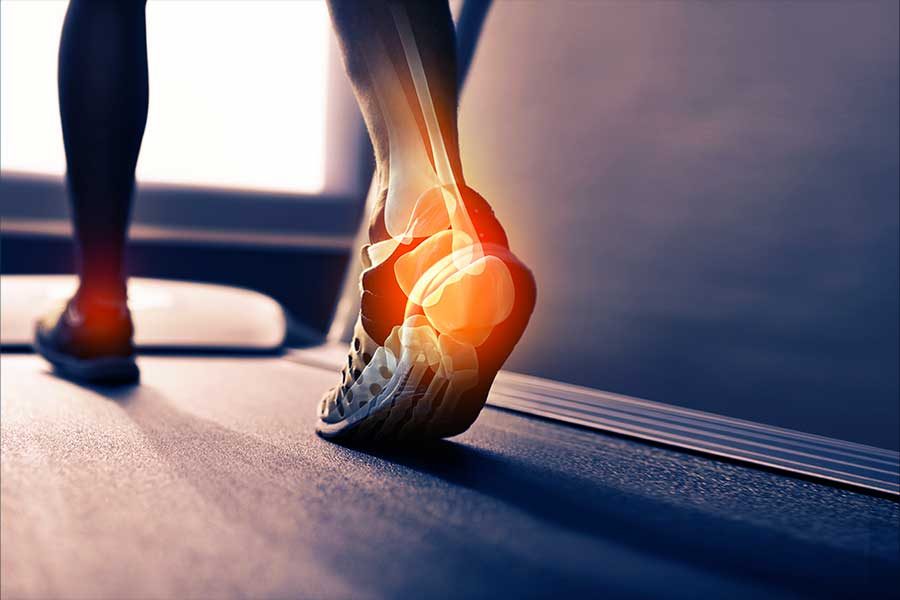
When creating a new model, to limit the number of prototypes and avoid the sometimes complex procurement of materials for laboratory testing, our teams work with you to design the digital model of the product. Depending on the issues at stake, this can take the form of a workshop to validate initial hypotheses, or a more in-depth study such as a Proof of Concept to present a project, or a unique 100% digital study that could lead to the launch of a first prototype.
Some examples of the benefits of digital simulation
Virtual prototypes
- Create digital tests equivalent to our customer’s existing mechanical and/or biomechanical tests
- Test a new product design and propose changes to meet the brand’s target criteria (durability, strength, weight, etc.).
- Create a parametric test model to iterate on future new designs. This model can then be transferred back to your teams for subsequent iterations.
- Combine different simulation techniques, such as musculoskeletal and finite element modeling. We are able to create complete models of the human body, giving access to data inside the body and products before the prototyping phase.
- As part of our drive to use bio-sourced materials with enhanced recyclability, we work with our customer to create products offering performance equivalent to that of the original product.
Performance... for the athlete
- Numerically represent product/human interaction by modeling realistic product loads,
- Create innovative digital tests, linked to biomechanical mechanisms, and validated through correlation analysis with athletes’ perceptions on the field.
- Predict product performance before the first prototyping phase, propose innovations and optimize the whole package to maintain the product’s attractiveness on its market.
- Enhance understanding of human movement, human perception and interactions between the human body and sports products
Transfer our knowledge of product/athlete interaction to the biomedical field, and adapt our models for products designed for the disabled.
Design processes
- Overhaul the engineering process by creating bridges between the various test models created to evaluate all the criteria by developing dedicated tools and interfaces (python, etc.).
- Support the transformation of the digital chain to enable fluid communication between R&D teams, designers, product managers…
- Support your technological and scientific watch by analyzing publications and attending professional events
- Prepare publications and presentations at conferences and symposia
- Design optimization: after validating a digital twin of the product, we redefine an optimal design using parametric and topological optimization techniques.
Because we believe in progress for mankind and are attentive to our customers’ needs, our experts will become your extended enterprise… Access unique expertise with complete flexibility!
Here are a few examples of how numerical simulations can be applied
Development of musculoskeletal models
When practicing a sport, the athlete often performs highly complex movements. These movements can be measured and analyzed in the laboratory using Motion Capture (MoCap) tools, which track markers located on different parts of the athlete’s body. Musculoskeletal modeling, thanks to software such as OpenSim, uses inverse dynamics to calculate the muscular forces required to perform the recorded movement. In this way, it is possible to determine the effect of different sports product designs on muscle activation and establish a link between these designs and the associated energy cost. Often, minimizing energy costs will indicate a gain in performance.
Study of the cushioning and energy return of a running shoe
The definition of cushioning can vary from one individual to another, from one brand of sport to another. What’s more, the need for cushioning also varies from one individual to another. Indeed, most runners have a heel-strike type of stride, and therefore need shoes that will cushion the shock at the start of their stride. This will be reflected in the presence of a passive peak on the ground reaction force curves. For runners with a midfoot or forefoot attack, cushioning is provided actively by the body’s muscles.
To meet the needs of these different types of runners, sports shoe constructions have evolved considerably in recent years, with the appearance of minimalist shoes designed to be as close as possible to man’s natural stride, shoes with very thick soles, or new shoe constructions with foams combined with carbon plates, designed to optimize energy exchanges between the start of the stride and propulsion.
Our expertise in modeling the human body and viscoelastic and carbon materials enables us to create finite element models of running and walking strides, and to analyze energy loss during heel strike, and energy return during the transition from heel strike to propulsion. This optimizes the geometric construction/material combination of sports shoe soles.
Aerodynamic study of a cyclist
When we think of a cyclist’s aerodynamics, we think of various champions who have spent long hours in wind tunnels to find the right position. We’re also thinking of the more exotic downhill positions. In all cases, numerical simulation, and more specifically CFD , can be used to estimate the impact of designs on the aerodynamic performance of riders.
Study of the deformation of a tennis ball
A tennis ball consists of a pressurized rubber core and a ‘felt’ made of a mixture of wool and nylon, which exhibit non-linear strain rate properties under high-speed impacts. The figure below shows high-speed video images of a tennis ball hitting a rigid plate at a speed of 30 m/s and the corresponding FE ball impact model created in Abaqus/Explicit. In this model, artificial Rayleigh damping was introduced into the material layers to account for hysteresis effects, while low strain-rate tensile tests as well as high-speed impact tests were used to calibrate the strain-rate dependence of the materials. Internal pressure was modeled using a membrane of hydrostatic elements sharing nodes with the rubber core. Simulated and experimental results were in good agreement with outgoing/incoming velocity ratios, impact time and ball deformation for a range of impact velocities from 15 to 50 m/s.
Study of the digital product design chain
More and more digital tools are being used to meet the needs of the various professions involved in product creation. The software used by designers, mold makers, CAD engineers and calculation engineers is different and sometimes incompatible. This calls for the use of software suites such as Dassault’s 3DExperience, complemented by pattern-making software for textile parts such as CLO 3D, or ExactFlat. Finally, when designers want to move towards parametric design or even calculation, tools like GrassHopper or Kangaroo are used. If the transition from one software to another is not possible with existing tools, our teams can create bridges.
In-house R&D project
Development of a flexible orthosis - Musculoskeletal model
The spine is an essential part of the human body and is often the cause of a worldwide problem: back pain. According to estimates, 2 to 5% of the world’s population currently suffers from a recognized pathology. The proportion of people suffering from back pain will continue to rise in the years to come: working seated in front of a computer, poor posture linked to the use of smartphones or the carrying of backpacks, particularly for children, all present unfavorable conditions.
Another determining factor is the ageing of the population, which is accompanied by an increase in the number of people potentially suffering from back pain.
The scientific community agrees on one thing: keeping physically active is vital. This activity must remain a source of pleasure, motivation and well-being.
We are therefore working on the creation of a digital core, with the aim of developing products (flexible corsets, sports products) aimed at improving posture while practicing a sport. The complementary nature of musculoskeletal and finite element modeling is ideal for simulating the postural correction provided by products, and thus finding innovative solutions.